


The best dog food for itchy skin may not be the one with the most soothing claims on the label. If your dog is constantly scratching, licking or chewing, confusing ingredients and recurring flare-ups can be frustrating. Food can play a part, but fleas and environmental allergies can also cause itchy skin, so changing diets is not a guaranteed fix.
The right protein and fats may still make a meaningful difference. For dogs sensitive to proteins they have eaten before, fish can be an alternative to common proteins. Marine omega-3 fatty acids EPA and DHA help support the skin barrier and a healthy coat. This guide explains what to look for in the best dog food for itchy skin, how to read ingredient labels and why a fish-only meal may suit some dogs. You will also learn when to seek veterinary advice and how to introduce a new food carefully, with examples of life-stage options from Harley & Marley’s range.
Key Takeaways
- Look for a protein your dog has not regularly eaten. Fish may be a useful option when assessing food sensitivities.
- The best dog food for itchy skin should suit your individual dog, with clear ingredients and appropriate complete nutrition.
- EPA and DHA from marine sources differ from plant-based ALA when considering skin and coat support.
- Grain-free food is not automatically the answer to itching. Consider your dog’s sensitivities and overall diet before choosing.
- Fish-only, life-stage-specific meals and fish oil are options to discuss with your vet when planning consistent nutrition.
Understanding the Root Causes of Canine Skin Irritation
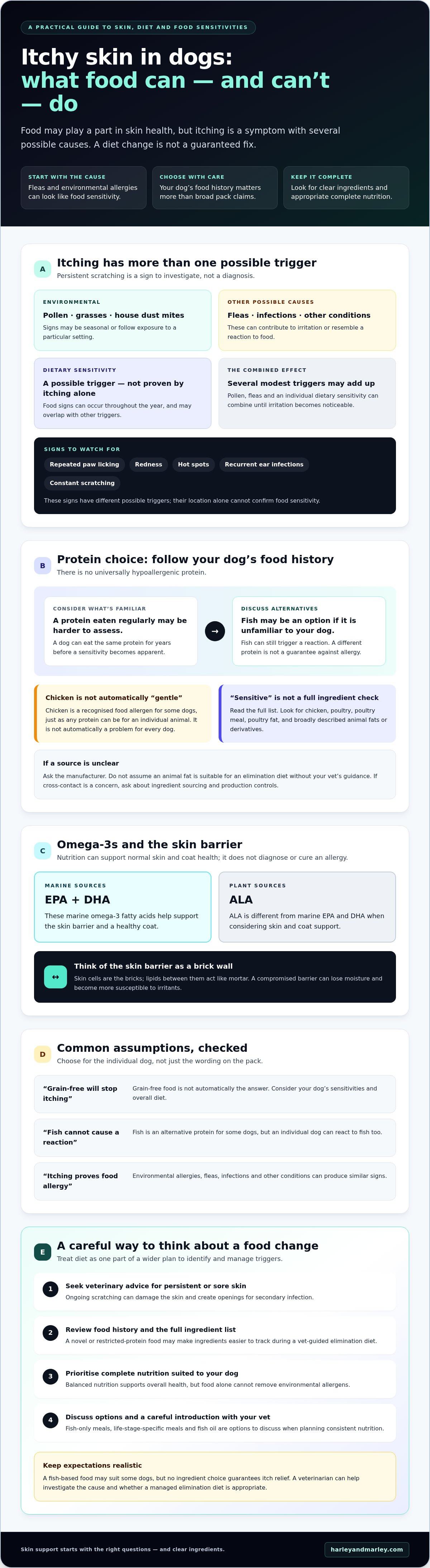
Persistent itching is a symptom, not a diagnosis. Environmental allergies are a common cause: pollen, grasses and house dust mites can irritate a dog’s skin, producing signs that look much like a reaction to food. Fleas, infections and other conditions can also contribute. This overview of canine skin irritation shows why it is risky to assume every itchy dog needs a new diet.
Watch for repeated paw licking, redness, hot spots, recurrent ear infections or constant scratching. These signs can have different triggers, and their location alone will not confirm a food sensitivity. If symptoms persist or the skin becomes sore, seek veterinary advice rather than relying on a “wait and see” approach. Ongoing scratching can damage the skin and create openings for secondary infection, making your dog more uncomfortable and treatment more complicated.
Environmental vs. Dietary Triggers
Environmental allergens may affect a dog seasonally or after exposure to a particular setting, while a food sensitivity can cause signs throughout the year. The two can overlap. The “allergic threshold” helps explain how several modest triggers, such as pollen exposure, fleas and an individual dietary sensitivity, may combine until the total irritation becomes noticeable.
Repeated licking and scratching can create a cycle: irritation prompts licking, licking inflames or breaks the skin, and damaged skin becomes more vulnerable to infection. Balanced, complete nutrition supports overall health, but food alone cannot remove environmental allergens. A veterinarian can help investigate the cause and advise whether a carefully managed elimination diet is appropriate.
The Role of the Skin Barrier
The skin barrier is the body’s primary immunological shield, helping keep irritants out while retaining moisture. Picture it as a brick wall: skin cells are the bricks, and the lipids between them form the mortar. When this structure is compromised, the skin can lose moisture and become more susceptible to external irritants, sometimes described informally as “leaky skin”.
A nutritionally complete diet provides the building blocks needed for normal skin maintenance, while deficiencies or poor overall nutrition may undermine skin and coat health. This does not mean a particular food will cure an allergy. When comparing the best dog food for itchy skin, look for clear ingredient information and complete nutrition. Consider a change as one part of a wider plan to identify and manage your dog’s triggers.
Why Protein Selection is the Secret to Managing Food Sensitivities
A dog can eat the same protein for years before a sensitivity becomes apparent. Chicken is not automatically a gentle choice: it is a recognised food allergen for some dogs, just as any protein can be for an individual animal. Persistent itching does not prove a food allergy. Environmental conditions and other causes can produce similar signs, so discuss ongoing symptoms with your vet before changing diets. Cornell University’s guide to atopic dermatitis explains one common allergic skin condition and why identifying the trigger matters.
For suspected food sensitivities, protein selection is about finding a source your dog has not reacted to, not choosing a protein that is universally “hypoallergenic”. A novel or restricted-protein food may make ingredients easier to track during a vet-guided elimination diet. Fish can be one option, particularly if your dog has not eaten it regularly. The best dog food for itchy skin is individual: your dog’s food history and the ingredient list matter more than broad claims on the pack.
Debunking the Chicken Myth
“Sensitive” on the front of a bag does not necessarily mean poultry-free. Check the full ingredient list, including the smaller print, for chicken, poultry, poultry meal, poultry fat and broadly described animal fats or derivatives. If the source is unclear, contact the manufacturer. Even when a fat contains little protein, do not assume it is suitable for an elimination diet without your vet’s guidance.
If you are looking for poultry-free dog food, checking every ingredient is more useful than relying on “sensitive” or “limited ingredient” wording alone. Harley & Marley’s stated formulation is fish-only, without meat or poultry ingredients. Ask the manufacturer about ingredient sourcing and production controls if cross-contact is a concern.
The Fish Advantage
Fish offers a different animal protein for dogs that may be sensitive to familiar ingredients. It is not a guarantee against allergy: a dog can react to fish, too. A single animal-protein source can, however, make a diet easier to assess by reducing the number of potential protein triggers. That is the practical benefit of lowering the dietary “antigenic load”, rather than a promise that the immune system will stop reacting.
Digestibility depends on the whole recipe and the individual dog. No protein is automatically easier for every gut to process. Fish also provides marine omega-3 fatty acids, which support skin and coat health, but it does not replace diagnosis or a properly managed elimination trial. If you are comparing options, explore fish-only dog food and check whether the ingredients align with your dog’s dietary plan.
The Science of Omega-3: Repairing the Skin Barrier from Within
Marine omega-3s can support skin health as part of a complete diet, but they are not a cure for every itch. Fleas, infections and allergies can all cause scratching, so consult your vet if discomfort persists. The common causes of itching in dogs extend well beyond nutrition.
Fish oil supplies EPA and DHA, fatty acids that can be incorporated into cell membranes and help regulate inflammatory responses. Their role is distinct from simply adding “oil” to a recipe: the type and amount of fatty acid matter. The body converts plant-based ALA, found in flaxseed oil, into EPA and DHA only inefficiently, so it is not a direct nutritional equivalent to marine sources.
Marine-Sourced Fatty Acids
Cell membranes need to remain flexible to function properly. EPA and DHA contribute to membrane structure, while marine omega-3s can help moderate inflammation and support the skin barrier. DHA also has important roles in brain and cognitive function, as well as contributing to healthy skin.
There is not one ideal Omega-6 to Omega-3 ratio that guarantees relief for every dog. Ratios alone can be misleading. Check the food’s nutritional information for the actual fatty-acid content, and ask your vet whether additional fish oil is appropriate alongside a complete diet. Harley & Marley offers fish-only dog food and fish oil. Its fish based dog food guide explains the role of marine nutrition. Treat this as dietary support, not a replacement for diagnosis or treatment.
Visible Results: From Dull to Glossy
Coat changes take time. With consistent omega-3 supplementation, clinical improvements in skin health are typically seen within 4 to 8 weeks, though results vary and the cause of the itching matters. Do not expect a guaranteed change on a fixed skin-cell turnover timetable.
Make progress easier to judge by taking a weekly photo in similar light and noting scratching, paw licking, redness, coat shine and visible flakes. A steadier coat lustre or less dander may be encouraging, but worsening redness, sores or persistent itching warrants veterinary advice. If you are considering a fish-based diet, explore fish-only dog food and fish oil and discuss any dietary changes with your vet.
Comparing Options for the Best Dog Food for Itchy Skin
No protein is hypoallergenic for every dog. The useful question is whether your dog has eaten it before and might be sensitive to it. Beef and chicken are common food allergens. Lamb may be familiar from previous diets, while venison, duck and fish can be novel options for some dogs. Novelty is personal, so check your dog’s food history with your vet before treating any protein as a safe choice.
Fish can be a practical option because a fish-only recipe gives you a clearly defined animal-protein source and supplies marine omega-3 fatty acids. But the replacement protein matters just as much as removing an ingredient. A grain-free food is not automatically better if it does not provide complete, balanced nutrition. Digestibility also depends on the whole recipe and the individual dog. Well-digested food can help make nutrients available to the body, but stool quality alone cannot diagnose an allergy or confirm a food’s nutritional value.
Eliminating the Grains
Grain-free diets may suit dogs whose needs or sensitivities call for them, but grains are not inherently harmful and should not be removed without a reason. Food allergies need careful assessment, as itching can have other causes and the suspected trigger may be a protein rather than a grain. If you are considering a change, ask your vet whether a structured elimination diet is appropriate and choose a complete food suited to your dog.
Some grain-free recipes use carbohydrate ingredients such as sweet potato or peas. Their presence does not establish that a food is suitable for your dog. Look at the full ingredient list, nutritional adequacy and protein source. Explore complete grain-free dog food as one option to assess, rather than assuming it is the answer for every itchy dog.
The “Clean Label” Standard
Choose transparency over claims such as “natural” or “sensitive”. Read the full label for named protein sources, added fats, colourings and preservatives, and ask the manufacturer if an ingredient’s source is unclear. Do not automatically blame artificial additives for a histamine response. A suspected reaction needs proper investigation. Likewise, do not assume that minimal processing guarantees better nutrition or that a particular preparation method preserves oils without evidence.
Harley & Marley is an Irish-owned specialist in fish-only dog food, with complete meals and fish oil. Its focus on marine nutrition may appeal to owners seeking an alternative protein, but no diet can promise to resolve every skin problem. When comparing the best dog food for itchy skin, review the formulation and your dog’s dietary history, then explore fish-only dog food as a potential fit to discuss with your vet.
Harley & Marley: Premium Fish-Based Nutrition for Itch-Free Living
A fish-only diet can offer a clearly defined alternative protein for dogs whose food history or veterinary advice points away from familiar proteins. Harley & Marley is an Irish-owned specialist in fish-only dog food, with complete meals for different life stages, fish oil and treats. Its marine-focused nutrition provides omega-3s for skin and coat support, but no food can promise to eliminate itching. The right choice depends on your dog’s sensitivities and the cause of their symptoms.
For larger dogs, explore the large breed dog food Ireland guide to learn about the breed-specific option. Choose a complete meal that suits your dog’s life stage, and check the label for nutritional information rather than assuming one formulation will meet every dog’s needs.
Quality also involves how ingredients are sourced and used. Harley & Marley highlights a sustainable, circular-economy focus. If your dog has a diagnosed food sensitivity, check ingredient details and discuss any diet change with your vet, especially if you are conducting an elimination diet.
Tailored for Every Stage
Puppies and older dogs have different nutritional needs, so select a complete food labelled for the appropriate life stage. The puppy food Ireland guide explores fish-based nutrition for growing dogs. For senior dogs, review the nutritional information and feeding guidance on the senior food, and ask your vet whether its fat and nutrient profile suits your pet. Fish-based Chews & Bites can also provide a reward option. Check their ingredients if you are tracking possible dietary triggers.
Make a Consistent, Considered Change
Unless your vet advises otherwise, introduce a new food gradually over around seven days, mixing increasing amounts of the new food with the old. Slow the transition if your dog develops digestive upset, and seek veterinary guidance if symptoms are severe or persist. For allergy assessment, avoid adding other new foods or treats during an elimination diet unless your vet approves them.
A monthly food box can make it easier to keep your dog’s chosen food consistent. You can also review the dog food bundle guide to understand the available bundle options. For a fish-based meal matched to your dog’s needs, explore Harley & Marley’s dog food range and discuss the best dog food for itchy skin with your vet.
Take the Next Step Towards a Healthier Coat
Persistent itching deserves a considered approach. Environmental triggers and food sensitivities can look alike, so seek veterinary guidance before assuming a diet change will solve the problem. If food is a factor, choosing a protein your dog tolerates and providing marine omega-3s may support skin and coat health as part of complete, balanced nutrition.
The best dog food for itchy skin is the one that fits your dog’s individual needs, ingredient history and life stage. Harley & Marley is Irish-owned and offers fish-only dog food, with grain-free options and complete meals for different life stages. Its recipes provide a poultry-free alternative for owners assessing protein sources, though no food can guarantee relief from itching.
Ready to compare fish-based options? Browse Harley & Marley’s range of premium fish-based dog food, and discuss any dietary change with your vet. With careful choices and the right support, you can take practical steps towards a more comfortable dog and a healthier-looking coat.
Frequently Asked Questions
Can dog food really help with itchy skin caused by seasonal allergies?
Food can support skin health, but it will not remove seasonal triggers such as pollen or grasses. A complete diet with suitable nutrients, including marine omega-3 fatty acids, may help maintain the skin barrier, while the allergy itself may need separate veterinary management. The best dog food for itchy skin depends on the individual dog and the cause of the irritation, so ask your vet before changing food.
How long does it take for a change in dog food to stop my dog scratching?
There is no guaranteed timeline, and a food change may not stop scratching if the cause is environmental, fleas or infection. If your vet recommends an elimination diet, follow their instructions consistently and avoid adding unapproved foods or treats, which can make results harder to interpret. Skin and coat changes take time. Seek veterinary advice if itching persists, worsens or causes sores rather than waiting for the new food to work.
Is fish-based dog food better than lamb for sensitive skin?
Neither protein is best for every dog. The useful choice is a complete food containing a protein your dog tolerates and has not reacted to. Their previous diet matters. Fish offers marine omega-3 fatty acids and can provide an alternative to familiar proteins, while lamb may suit some dogs too. If you are investigating a food allergy, ask your vet whether a controlled elimination diet is more appropriate than switching proteins at random.
What ingredients should I avoid if my dog has itchy skin?
Avoid ingredients your dog is known or suspected to react to, as advised by your vet. Read the full ingredient list, checking for named proteins and less specific terms such as poultry derivatives or animal fats if you are trying to exclude a protein. Do not assume grains, preservatives or colourings are the cause without evidence. During an elimination diet, unplanned treats, chews and table scraps can undermine the trial.
Do I need to add extra fish oil if my dog is already on a fish-based diet?
Not necessarily. A fish-based food may already provide omega-3 fats, but the amount and type can vary between recipes. Check the nutritional information and ask your vet before adding a supplement, particularly if your dog has a medical condition or takes medication. More is not automatically better, and adding fish oil without considering the full diet can affect its overall balance.
Can a grain-free diet help with my dog’s paw licking?
Only if a grain is identified as a trigger. Grain-free food is not a general remedy for paw licking. Dogs may lick their paws because of environmental allergies, parasites, irritation or infection, as well as a possible food sensitivity. Do not remove grains based on this symptom alone. Ask your vet to investigate the cause, then choose a complete diet that suits your dog’s needs and dietary history.
Is chicken a common cause of skin allergies in dogs?
Chicken can trigger a food allergy in some dogs, but it is not automatically harmful or unsuitable for every pet. A reaction depends on the individual dog, and itching alone cannot confirm chicken as the cause. If your vet suspects a food allergy, check labels carefully for chicken and poultry ingredients, including derivatives, and follow a structured elimination plan rather than simply switching foods.
What is the best way to transition my dog to a new food for their skin?
Unless your vet advises a different plan, introduce the new food gradually over about seven days, mixing increasing amounts into your dog’s current meals. If digestive upset develops, slow the change and seek advice if it continues. Keep treats and other foods consistent, especially during an allergy investigation, and record changes in scratching, paw licking and coat condition. Contact your vet if symptoms worsen or your dog seems unwell.